Summary
Wage and price setting equations in the labor market, deriving the natural rate of unemployment as the equilibrium where .
The IS-LM Model is a great simple model to think about recessions and ways to fight them, but once the economy is close to its potential output, we need to worry about the supply side as well. In the next few lectures, we will endogenize the inflation rate, with the story starting in the labor market.
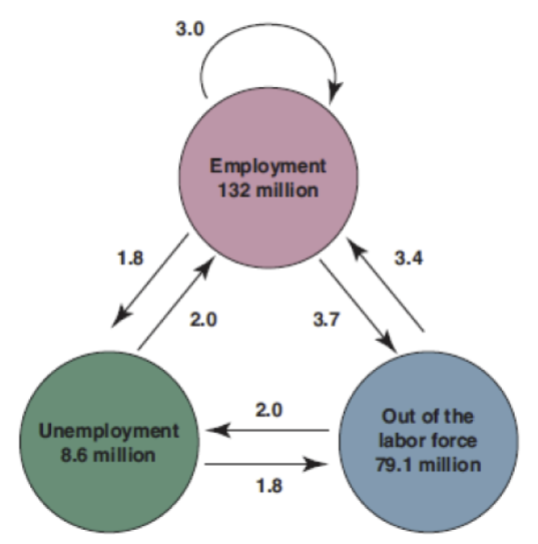
When the unemployment rate is high, workers are worse off in multiple ways. First, employed workers have a higher chance of losing their job, and unemployed workers have a lower chance of finding a job.
Wage Determination
The labor market indicators are crucial for wage determination and goods/services pricing. At times, wages are set by collective bargaining, where unions and firms decide on fair wages (~10% of US workers’ wages, much larger in Japan and the EU). In general the higher the skill needed, the more likely it is that the bargaining happens between employers and individual employees. However, the macroeconomic drivers of wages are similar in both instances.
Workers’ wages are normally above their reservation wage, which is what would make them indifferent about working or being unemployed. In general, the lower , the higher the wages. Their bargaining power depends on how costly it is for firms to find workers and how hard it is for workers to find another job if they were to leave. At the aggregate level, we write the wage setting equation as:
where is the expected price level and is a catchall for factors that affect wages (unemployment benefits, employment protection legislation, etc.).
Price Determination
The prices set by firms depend on their costs, which in turn depends on the production function:
Where is output, is employment, and is labor productivity (output per worker). Let us assume , so producing one more unit of output requires one more worker.
This production function assumes the marginal cost of production equals . Firms set prices according to a markup over their marginal cost:
We can rewrite this price setting equation in terms of the real wage:
The higher the markup, the lower the real wage firms want to pay.
The Natural Rate of Unemployment
Note
There’s nothing natural about the natural state of unemployment :)
The natural rate of unemployment is the equilibrium level of unemployment when . We think of this as the average unemployment rate in the medium/long run. Assuming , we can write the wage setting equation as:
The higher , known as the natural rate of unemployment, the lower the real wage consistent with the wage setting equation.
Hence, we have the following in equilibrium:
Example
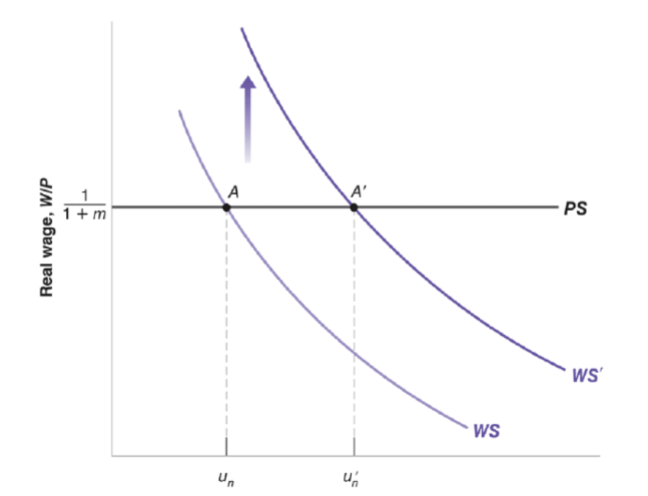
Higher unemployment benefits ( up):
Example
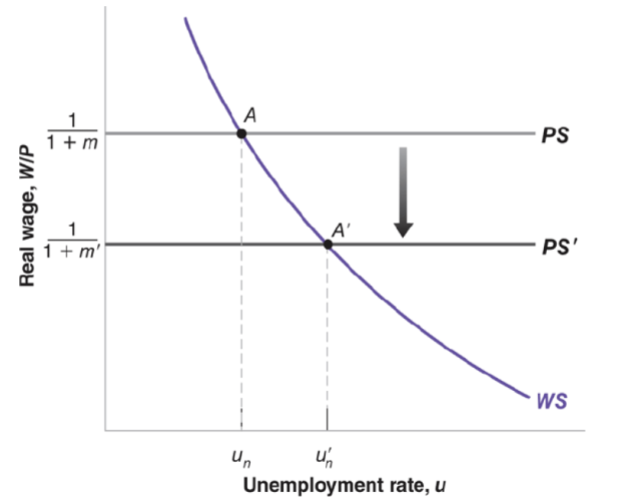
Higher markups ( up):