Summary
Interactions between Output and Capital
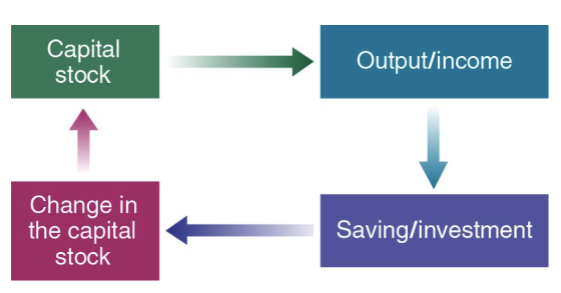 The Solow model, which we will discuss in the next few lectures, adds in saving to our previous models.
Assume is constant (no population growth) and recall from modeling growth that
where means more capital per worker increases output, and captures decreasing returns to capital.
Assume the economy is closed with no public deficit, so investment equals saving: . (This is how we derived IS - investment = savings). Moreover, assume private saving is proportional to income, where is the saving rate, so
Capital Accumulation
Capital stock evolves as
where is the depreciation rate. In per-worker terms:
The change in capital per worker is saving per worker minus depreciation per worker. Substituting :
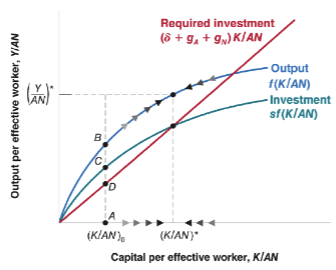
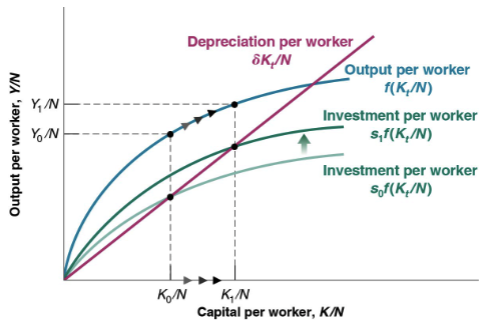
This is the key equation: capital per worker grows when investment per worker () exceeds depreciation per worker ().
Example
An increase in the saving rate shifts the investment curve up, raising the steady-state level of capital and output per worker.
Steady State
In the steady state, capital per worker is constant (), so investment exactly offsets depreciation: s f(K^*/N) = delta K^*/N.
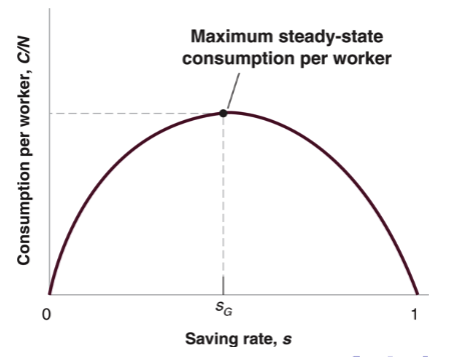
We can also find the saving rate that maximizes steady-state consumption per worker:
To get a sense of magnitudes, assume so that
Setting the left side to zero and solving:
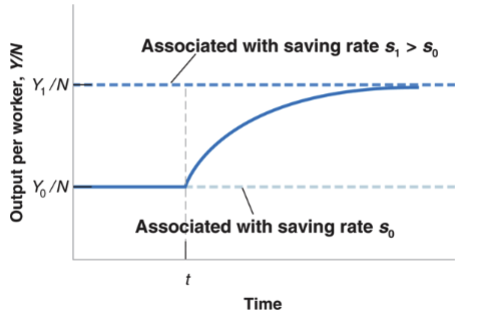
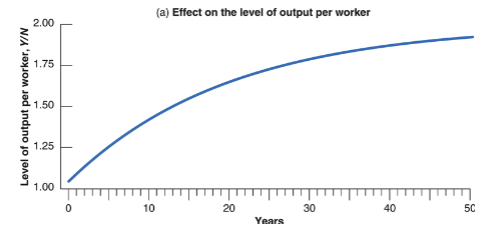
K^*/N = (s/delta)^2 \ Y^*/N = sqrt(K^*/N) = s/deltaSo in the long run, doubling the saving rate doubles output per worker. However, it takes a long time to reach the new steady state, even when we double the saving rate:
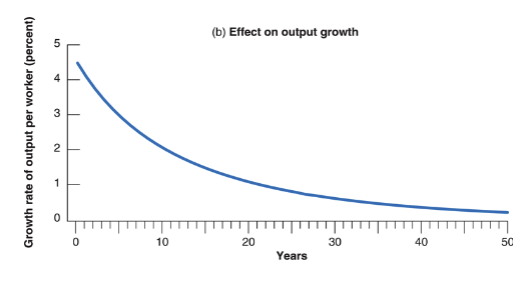
 Similarly, the effect on output growth rate decays slowly back to zero:
Adding Population Growth
If there is population growth at rate , capital per worker is now “diluted” by the growing workforce. The equation becomes:
Population growth acts like additional depreciation: you need more investment just to keep capital per worker constant.
Example
Assume (no technological progress).