Summary
We want to modify the Solow model to have human capital. This allows the skills of workers to increase separately from technological progress.
is the amount of time spent acquiring human capital (i.e. years of schooling). If , one year of schooling raises by 10%. In per-worker terms (not effective worker):
Balanced Growth
Assume in steady state , then
Adding human capital doesn’t change the determinants of steady-state growth.
From the capital accumulation equation ():
Solving for :
Human capital doesn’t affect steady-state growth but influences the level of output per worker.
Relative Output per Worker
Consider output per worker relative to the US:
Assuming the same rate of technological progress across countries:
The Solow Residual
Solow assumed was identical across countries, i.e. they could share technology, but that is a bold claim. If we assumed , the world would be a lot more equal:
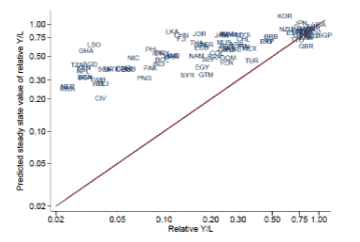 We can estimate technology from the Solow residual:
You can now compute
Differences in explain about 1/2 to 2/3 of the differences in output per worker across countries.
Conditional Convergence
Some countries grow slowly despite being poor. Conditional convergence explains that countries grow faster the farther they are from their own steady state. Poor countries have low steady states, so they are already close to it.