Summary
Openness in Goods and Financial Markets
In goods markets, you can choose between domestic and foreign goods, with tariffs and quotas as impediments. In financial markets, you can choose between domestic and foreign assets, with capital controls as impediments.
Note
In factor markets, firms can choose location of production and workers where to work.
Openness also implies that booms and recessions spread from one country to the others (i.e. the Great Recession of 2008). The US have become increasingly open. Tradable goods represent goods that compete with foreign goods in domestic or foreign markets (close to 60% of US aggregate output). The US is at the low end of export ratios.
Exchange Rates
The nominal exchange rate is the price of the domestic currency in terms of foreign currency. Nominal appreciation/depreciation are an increase/decrease in the price of the domestic currency in terms of a foreign one.
The real exchange rate is the price of domestic goods relative to foreign goods. Appreciation/depreciation work in a similar way in real terms.
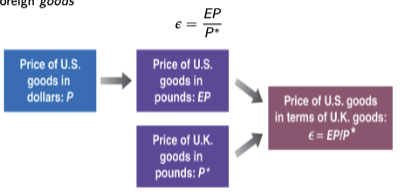
Example
This is the US Balance of Payments in 2018. Notice the net capital flows, which are an increase in net foreign indebtedness (funding), and gross capital flows, which are portfolio decisions.
Example
Expected returns from holding 1-year US vs. 1-year UK bond
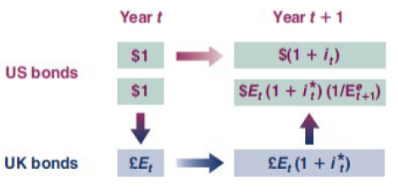
Arbitrage implies that
This relation is the uncovered interest parity condition, which means that in equilibrium financial investors must be indifferent between holding the two bonds. Otherwise, they’d flock to the one with higher expected return. With some approximations:
Arbitrage by investors means the domestic interest rate must equal the foreign interest rate minus the expected appreciation rate of the domestic currency.