Summary
Growth is the steady increase in aggregate output over time. We will shift our focus from short/medium-run economic fluctuations to growth and output in the long run.
Example
The US GDP is >50x that of 1890, and per capita, it increased by a factor of 10.
We care about growth because we care about the standard of living. Output per person is more important than total output. When comparing the standard of living across countries, we use purchasing power parity (PPP) numbers, which adjust for purchasing power of different countries to account for the fact that some things are much cheaper in other countries.
To adjust GDP for cross-country comparisons, we use a common basket of prices to correct for differences in price levels across countries.
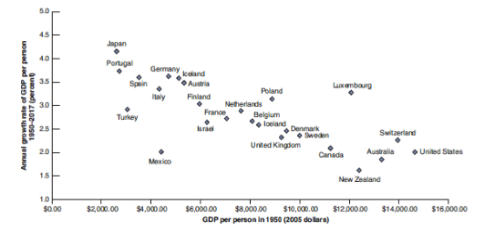
In general, countries with lower levels of output per person in 1950 have grown faster.
 In general, the GDP per capita of Western Europe and the western offshoots is much higher than in other parts of the world.
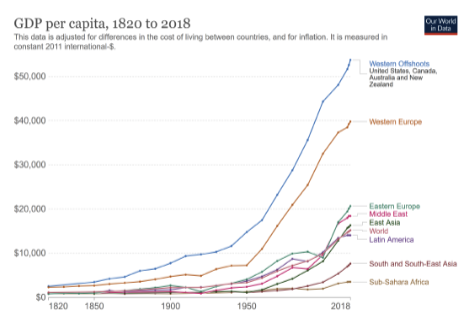 From the end of the Roman Empire to c. 1500, Europe was in a Malthusian trap, where output per person stagnated due to little technological progress. Even between 1820-1950, US growth was still 1.5% per year. Sustained growth is a quite recent phenomenon.
Modeling Growth
The aggregate production function
depends on the state of technology. With constant returns to scale:
With decreasing returns to capital, increases in (with fixed ) lead to smaller increases in output.
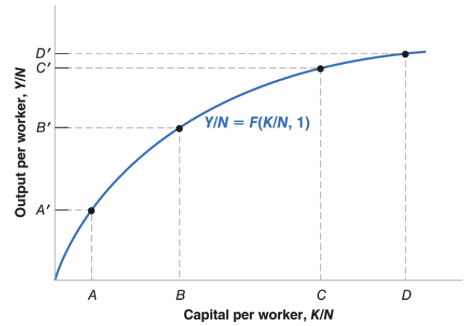 Decreasing returns to labor means increases in (with fixed ) lead to smaller increases in output. Let
Then
This shows there’s an increasing relation between capital-per-worker and output-per-worker. Growth per-worker comes from capital accumulation and technological progress.
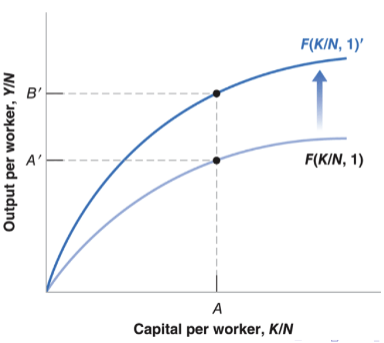 Technological Progress and Growth shifts the production function up, which leads to more output per worker at a given level of capital per worker.